
🎧 24×7 Support
From Raw Research Data to a Submission-Ready Dissertation
Client: Amit Sen Sharma
Academic Researcher: Koushiki Sen Sharma
Research Topic: Examining the Influence of Psychological Capital on Employee Well-being and Job Performance in Service Organisations
Discipline: MSc Applied Psychology – Industrial & Organizational Psychology
Core Support: SPSS guidance • statistical interpretation review • revision feedback • formatting support • submission-readiness review

The Client Brief & Initial Challenge
A detailed academic format had to be converted into a manageable workflow.
The client required support in turning a detailed dissertation brief into a clear and manageable academic workflow. Excellence Innovations provided guidance, review, and feedback across the dissertation structure, from literature review and methodology to SPSS-based results, discussion, conclusion, references, and submission preparation.
Key support areas included:
• Reviewing research tools for administration, scoring, reliability, validity, and interpretation.
• Checking alignment between methodology, hypotheses, statistical analysis, and written findings.
• Guiding the presentation of SPSS tables with concise academic interpretation.
• Supporting contents pages, numbering, appendices, formatting, and submission readiness.
• Ensuring SPSS findings were integrated into the dissertation narrative rather than presented as isolated outputs.ve.
Understanding the Study Before Analysing the Data
Excellence Innovations reviewed the alignment between the research design, measurement tools, and planned SPSS analysis.
STUDY FRAMEWORK
• Psychological Capital: hope, self-efficacy, resilience, and optimism
• PCQ-24: Psychological Capital
• WEMWBS-14: Mental well-being
• 10-item Job Performance Self-Report Scale: Perceived job performance
• Data collection: Online survey
• Analysis: SPSS
Guidance focused on ensuring that the selected scales, variables, hypotheses, and statistical analysis remained methodologically consistent.
SPSS Analysis & Results Interpretation
The raw output was organised into an academic results story.
The final Results chapter reported a combination of demographic comparison, reliability testing, descriptive statistics, correlation and regression. The objective was not merely to display software output, but to explain what the numbers meant for the research questions and hypotheses.
Excellence Innovations provided statistical review and interpretation guidance across the main SPSS procedures:
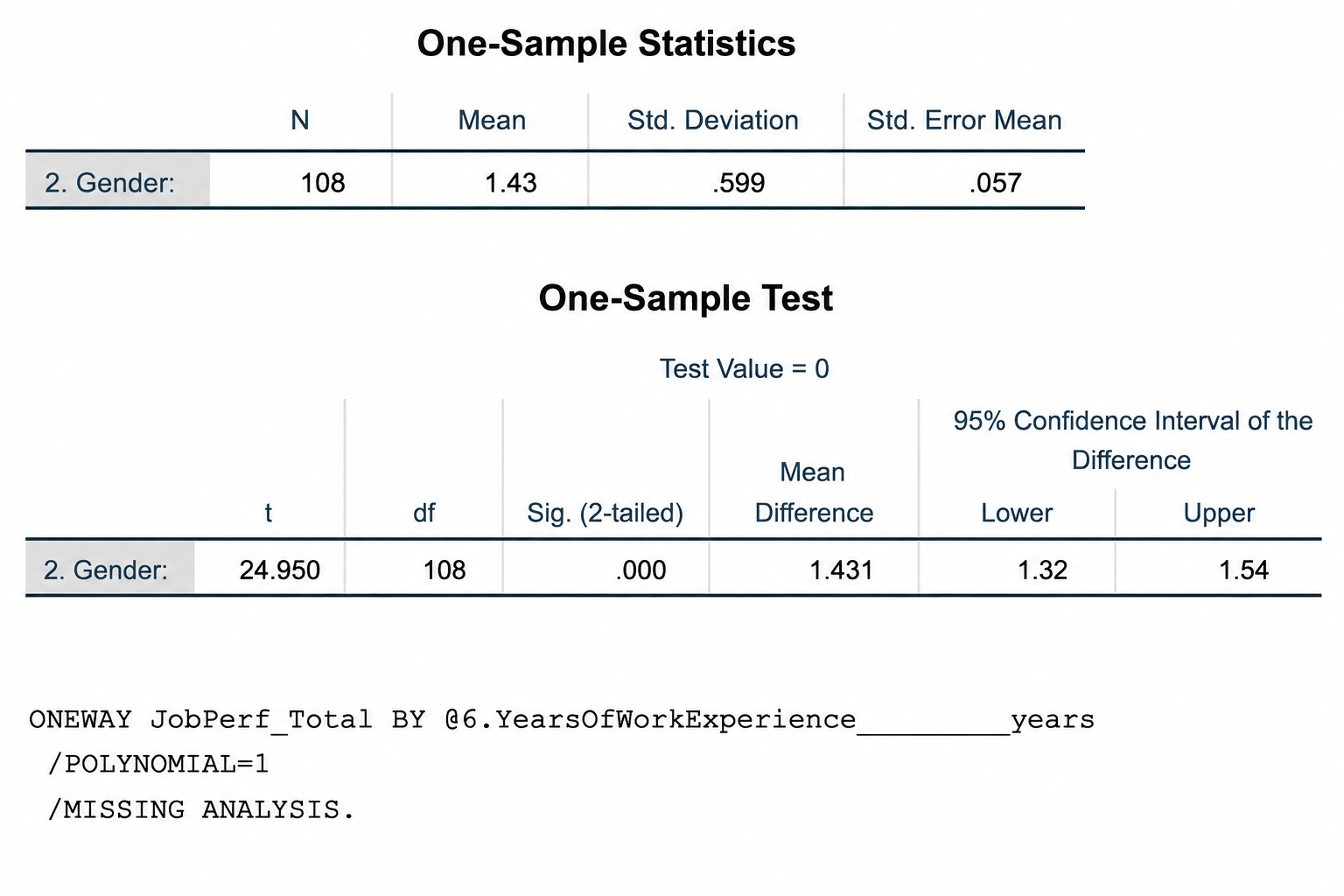
• Independent-samples t-tests – gender differences in Psychological Capital, well-being, and job performance.
• One-way ANOVA – job-performance differences across work-experience groups.
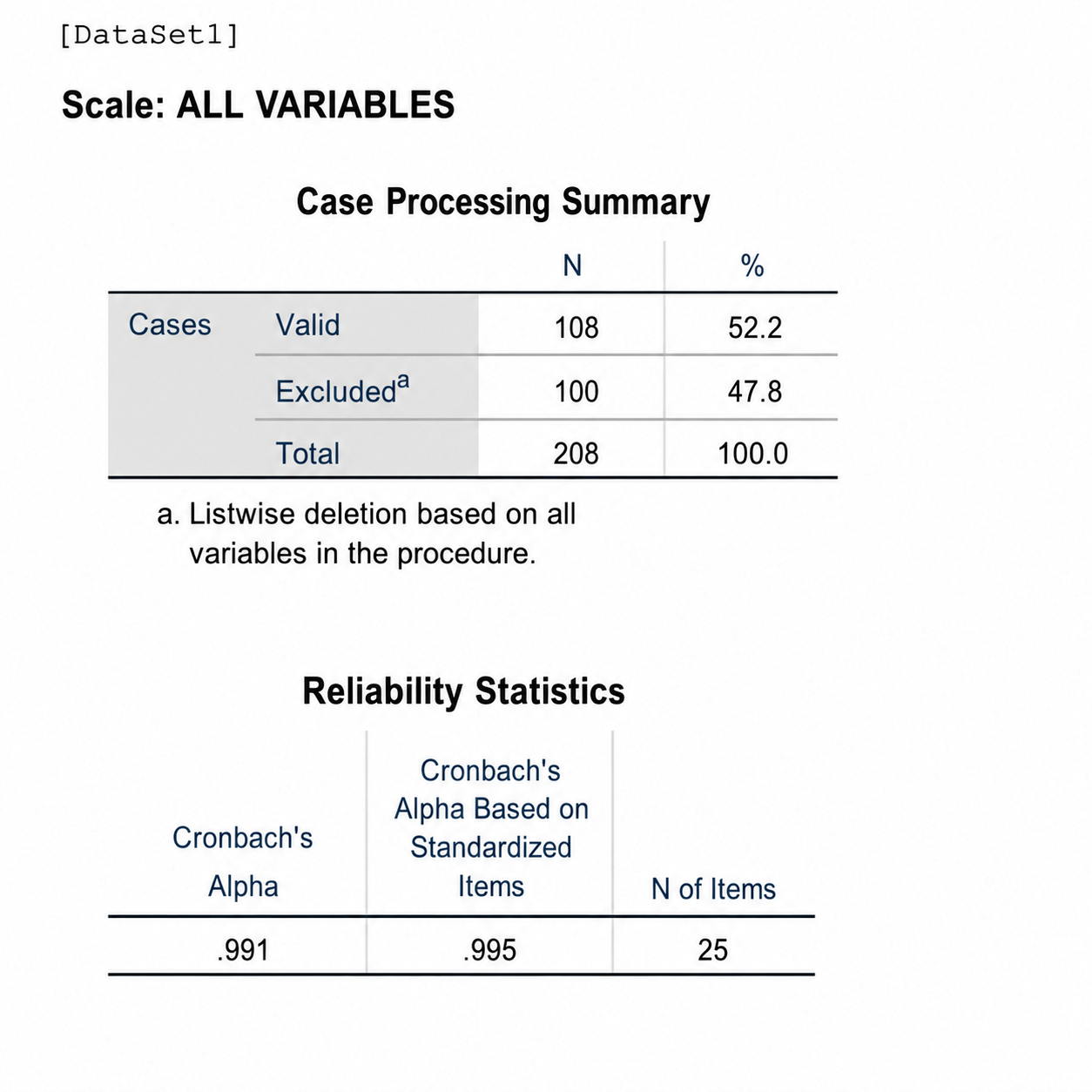
• Cronbach’s alpha – reliability of the three measurement scales.
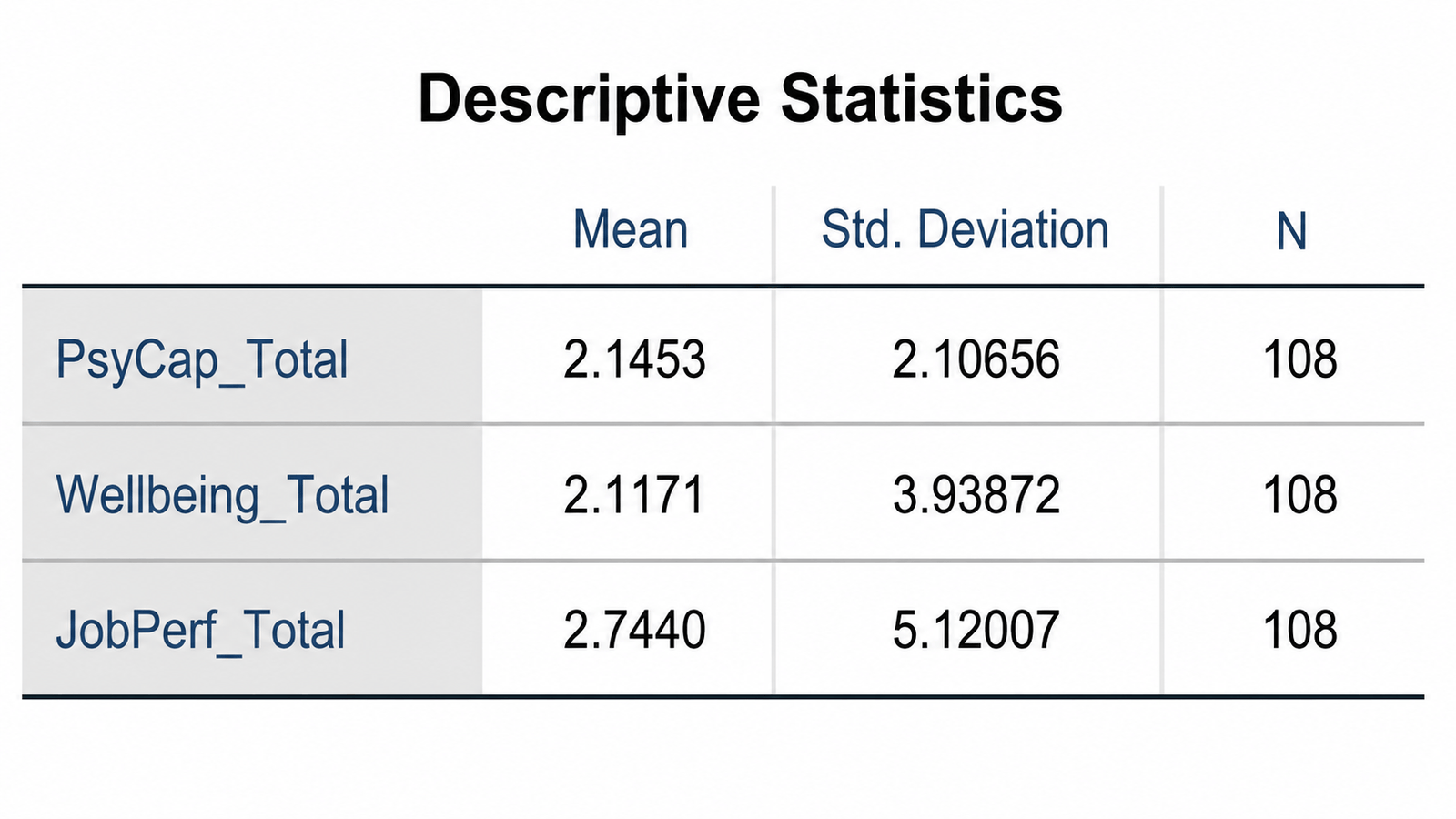
• Descriptive statistics – summary of the principal study variables.
• Pearson correlations – relationships among Psychological Capital, well-being, and job performance.
• Simple linear regression – assessment of the predictive role of Psychological Capital.
Feedback focused on ensuring that each test was appropriately interpreted and linked to the relevant research question and hypothesis.
Supervisor-Style Revision Cycle
After the draft and SPSS analysis were prepared, Excellence Innovations provided focused review and revision guidance based on the correction list received by the client.
• Review in-text citations using Zotero-supported referencing.
• Add clear source lines beneath SPSS tables.
• Remove duplicate references and verify DOIs/links where required.
Include the calculation sheet in the appendix/annexure.
Supervisor-Style Revision Cycle
• Check R² reporting and scale citations for PCQ-24, WEMWBS, and Job Performance.
• Provide feedback to make the Discussion and Conclusion more precise before final supervisor review.
• Include the calculation sheet in the appendix/annexure.
Finalization, Output & Submission Readiness
Once the corrections were incorporated, Excellence Innovations provided final review and submission-readiness support across the complete dissertation package.
• Checked that SPSS interpretations were properly integrated into the Results chapter.
• Reviewed alignment between the Discussion, Conclusion, and reported findings.
• Verified citation and reference corrections across the main text.
• Checked that calculation and reliability materials were retained in the appendices.
• Reviewed front matter, TOC, page flow, and overall structure for binding readiness.
• Supported final checks of the PDF and working dissertation files before submission.
The Client Journey: From Draft to Binding
The case study reflects a clear guidance and review journey. Excellence Innovations first helped clarify the required dissertation structure and length, then reviewed the dissertation and data sheet. Support continued through SPSS interpretation, targeted revision feedback, and final checks of the front matter, appendices, page numbering, table of contents, and binding requirements.
SPSS SOFTWARE OUTCOME
Excellence Innovations reviewed the reported SPSS findings and supported their academic interpretation. Reliability was very high (Cronbach’s Alpha = 0.991), while mean scores were 2.1453 for Psychological Capital, 2.1171 for well-being, and 2.7440 for job performance.
The regression results showed a strong, statistically significant association between Psychological Capital and well-being (R = .977, R² = .955, p < .001). Feedback focused on ensuring these findings were clearly linked to the research objectives and interpreted without overstating the evidence.

PROJECT JOURNEY
Brief & structure review → data/dissertation review → SPSS guidance → interpretation support → correction feedback → final review → binding-readiness checks → client review
Client Feedback
Amit Sen Sharma.
“Excellent experience, it helps us a lot. I would recommend to others as it is very helpful. Well communication and very much supportive staff. Their time Management is excellent.”