
Manuscript editing · Journal formatting · Statistical review
Manuscript editing services for journal publication.
Language, structure, formatting and statistical reporting — corrected together by PhD editors who have published in your field. Not four vendors. One manuscript back, ready to submit.
No payment before you see the work
1,200+
Manuscripts edited
48 hrs
Standard turnaround
12 mo
Free re-edit window
100%
Confidential · NDA on request
Most rejections are not about your science.
Your research is finished. Your data is analysed. But the manuscript keeps coming back — desk-rejected for language, returned for formatting, or hit with reviewer comments about how your statistics are reported.
Editors at indexed journals reject manuscripts before peer review for four recurring reasons: unclear English, structural problems in the Methods and Discussion, incorrect reference formatting, and statistical results reported in a way reviewers cannot verify.
We fix all four. Our editors hold doctorates in their subject areas, and — unlike most editing companies — our in-house data analysis team reviews your analysis alongside the language edit. You get one manuscript back instead of paying two vendors and reconciling their changes yourself.
We work with researchers submitting to SCI, SSCI, Scopus, Web of Science, ABDC and UGC-CARE indexed journals across management, business, social sciences, engineering, computer science, education, nursing and the life sciences. Editing sits inside our wider PhD research support — if your manuscript is not written yet, start there instead.
Related Case Studies
See how we’ve helped students with real data projects like these
What the edit covers.
01 · Language
Language editing
Grammar, syntax and punctuation throughout. Sentence-level clarity. Consistent academic tone. Correction of the article, preposition and tense errors that mark a manuscript as non-native English. Delivered with tracked changes.
02 · Structure
Substantive editing
We reorganise paragraphs where the argument breaks, tighten a bloated Introduction, check that Results answer your research questions, and make sure the Discussion connects findings to literature instead of repeating Results.
03 · Format
Journal formatting
Reformatted to your target journal’s author guidelines — word limits, abstract structure, heading levels, figure and table captions, reference style, supplementary files. From the journal’s actual guidelines page, not a template.
04 · Response
Response to reviewers
Point-by-point response letters addressing each comment with the corresponding revision marked. Most resubmissions fail because authors defend rather than respond. We help you frame revisions that close the comment.
05 · Selection
Journal selection
Shortlisting based on your manuscript’s scope, methodology, indexing requirements and realistic acceptance likelihood. We flag predatory journals to avoid — a growing problem in every field we work in. Related: research article writing.
06 · Conversion
Thesis to article
A thesis chapter and a journal article are different documents. We restructure to article format, cut to the word limit, reframe the literature review, and rewrite the discussion for a journal audience rather than an examination committee. Still drafting? See dissertation and thesis support.
The part other editing services skip
Statistical review, included in the same edit.
When a reviewer writes “the model fit indices are inadequate” or “report effect sizes”, a language editor cannot help you. Our analysts can — they work in-house, on the same manuscript, at the same time.
- Internal consistency — test statistics, degrees of freedom and p-values checked against each other
- Effect sizes and confidence intervals — added where journals now require them alongside significance
- SEM fit indices — CFI, TLI, RMSEA and SRMR reported to current standards
- Reliability and validity — Cronbach’s α, composite reliability, AVE, discriminant validity for scale-based research
- Assumption checks — documented where the journal expects them
- Statistical tables — reformatted to APA 7, AMA or journal-specific conventions
Working in SPSS · AMOS · SmartPLS · STATA · R · NVivo · Python. If results need re-running to satisfy a reviewer, we do that too.
From Our Blog
Guides on manuscript and publication

How it runs.
STEP 01
Send the manuscript
Upload your file with the target journal name. No journal chosen yet? Tell us the field and we will suggest options based on scope and indexing.
STEP 02
Free sample edit and fixed quote
We edit 500 words of your actual manuscript at no cost, so you see exactly what you are buying. Your quote is fixed on word count and service level. No revision to the price after we start.
STEP 03
Two-stage edit
A subject editor works first. A senior editor reviews the edit. If statistical review is included, our analyst works in parallel and their comments are integrated before delivery.
STEP 04
Review and revise
You receive a tracked-changes file, a clean file, and an editor’s note explaining substantive changes and flagging anything needing your decision. Revisions unlimited within scope.
STEP 05
After peer review
Reviewer comments arrive months later. Send them to us — re-editing of the revised manuscript is free for 12 months from your original order.
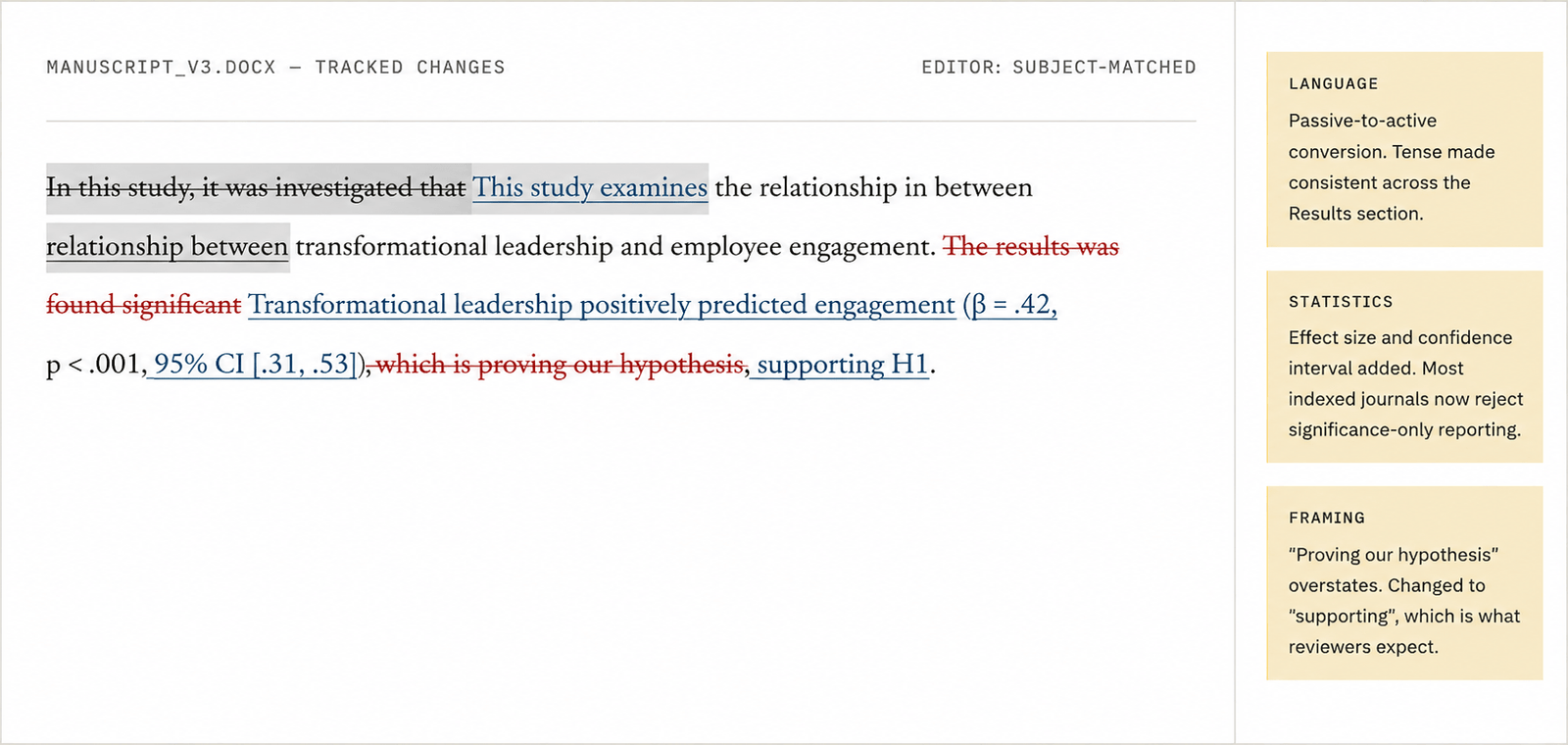
One paragraph, before and after.
From a management manuscript accepted after revision. Published with the author’s permission. More in our edited samples and published case studies.
Author draft
The findings of this research is showing that there is a significant impact of the training programs on the performance of employees. It was also found that the employees who are attending more trainings, they are performing better which is proving that our second hypothesis is correct.
After editing
Training participation significantly predicted employee performance (β = .38, p < .001, 95% CI [.24, .52]). Employees who attended more training sessions reported higher performance scores, supporting H2.
Subject–verb agreement and comma splice corrected , Present continuous changed to past tense, consistent with Results convention ,Effect size and confidence interval added — the target journal requires both , “Proving that our hypothesis is correct” softened to “supporting H2”; overstated causal language is a common reviewer objection , 62 words reduced to 33, against a strict word limit
What manuscript editing cannot do.
Editing improves how your research is presented. It does not change what your research found.
No editing service can guarantee journal acceptance, and any service that promises it is misleading you. Acceptance depends on the novelty, rigour and fit of your work — decisions only editors and reviewers make.
We also do not write manuscripts reporting research we have not seen the data for, and we do not ghost-author. Our role is editorial: clarity, structure, formatting and statistical presentation of work you have done. Authorship stays yours.
We follow COPE and ICMJE guidance on the line between editorial assistance and authorship, and we provide an editing certificate you can disclose to your journal. Most journals require that disclosure. All of them respect it. Our full position is set out in our academic integrity and fair use policy.
Where editing sits in the process.
Manuscript editing is one stage. These are the services either side of it.
Before the manuscript
PhD research assistance : Methodology design, literature review, research framing
Research article writing : Drafting the paper from your findings
Dissertation and thesis support : Chapter structure and supervisor revisions
Analysis behind the results
SPSS statistical analysis: Descriptives, regression, ANOVA, reliability
SmartPLS and SEM analysis: Path models, measurement models, fit indices
NVivo qualitative analysis: Coding, thematic analysis, matrix queries
Data science and analytics :Python, R and machine-learning workflows
Standards and proof
IEEE paper format guidelines : Section order, figures, reference rules
Edited samples : Real before-and-after manuscript extracts
Meet our editors : Credentials and subject areas
Academic integrity policy : What we will and will not do
Questions authors ask.
What does manuscript editing include?
Correction of grammar, spelling and punctuation; improvement of sentence clarity and academic tone; structural editing of sections that do not flow; formatting to your target journal’s guidelines; and correction of reference style. At Excellence Innovations it also includes review of how your statistical results are reported.
How much do manuscript editing services cost?
Charged per word, based on level of editing. Light language editing costs least; substantive editing with journal formatting and statistical review costs more. You get a fixed quote after we review the manuscript, and a free 500-word sample edit before paying anything.
Will editing guarantee my paper is accepted?
No, and no service can honestly promise this. Editing removes the reasons manuscripts are rejected without review — unclear language, poor structure, incorrect formatting. Acceptance still depends on the scientific contribution, which is the journal’s decision.
What is the difference between proofreading and manuscript editing?
Proofreading is a final surface check for typos, spelling and punctuation. Manuscript editing goes deeper: it restructures unclear sections, improves argument flow, corrects terminology, and formats to journal requirements. If your manuscript was rejected for language, proofreading is not enough.
Do journals allow the use of professional editing services?
Yes. Elsevier, Springer, Wiley and Taylor & Francis all explicitly recommend professional language editing for authors whose first language is not English. Many journals ask you to acknowledge editorial assistance in the acknowledgements section, and we provide an editing certificate for that purpose.
How long does manuscript editing take?
Under 3,000 words is normally returned within 48 hours. Longer manuscripts take three to seven days. Express 24-hour turnaround is available. Statistical review adds one to two days.
Can you edit a manuscript that has already been rejected?
Yes, and this is a large part of our work. Send the rejection letter or reviewer comments with your manuscript. We address the specific issues raised, and if you are switching journals we reformat for the new one.
Will you check my statistical analysis?
Yes, on Publication Ready and Complete Support. We verify that test statistics, degrees of freedom and p-values are internally consistent, that effect sizes and confidence intervals are reported, that SEM fit indices meet current reporting standards, and that reliability and validity statistics are complete. We work in SPSS, AMOS, SmartPLS, STATA and R. If the analysis itself needs to be re-run rather than re-reported, that is handled by our data analysis service.
Can you convert my thesis chapter into a journal article?
Yes. We restructure the chapter into article format, cut it to the journal’s word limit, reframe the literature review, and adjust the discussion for a journal audience rather than an examination committee. If the thesis itself is still in progress, see dissertation and thesis support.
Is my manuscript kept confidential?
Yes. Your manuscript is never shared, stored beyond the project, published as a sample, or shown to anyone outside the assigned editor and reviewer. We sign a non-disclosure agreement on request at no charge.
What file formats do you accept?
Microsoft Word (.doc, .docx) and LaTeX. If you work in LaTeX, mention it at the quote stage so we assign an editor who works in that format.