
about us
From Process Problems to Process Improvement
Client Name: Amitava Bhattacharyya
Project: Six Sigma Black Belt Assignment – LSS Case 27
Support Provided: Academic guidance, Six Sigma analysis review & statistical interpretation support
Software Used: Minitab
Methodology: Six Sigma DMAIC
Project Area: Manufacturing Quality & Process Improvement
Final Outcome: Project refinement support completed & five-star client review

The Client’s Journey
Every technical academic project begins with understanding the brief, assessment expectations, and analytical requirements. Amitava Bhattacharyya approached Excellence Innovations for academic guidance and review support on a Six Sigma Black Belt assignment.
The project required careful interpretation of the supplied case data, Minitab-based statistical analysis, and structured DMAIC reasoning. Our role focused on reviewing the analytical approach, guiding the interpretation of results, and helping the client strengthen the project’s overall methodological structure.
The project combined
Six Sigma DMAIC Guidance
Minitab Analysis Review
Manufacturing Data Interpretation
Statistical Interpretation Support
Academic Writing & Refinement
The Initial Enquiry
After the initial discussion and voice call, the client shared the Excel dataset (“LSS Case 27.xlsx”) and supporting case document (“LSS Case 27.pdf”). Excellence Innovations then provided integrated review and guidance support, helping the client align the case data, Minitab analysis, DMAIC methodology, and academic presentation within one coherent workflow.
The initial conversation documents the client’s request for guidance and review support on a Six Sigma Black Belt assignment, followed by discussion of the project guidelines and analytical requirements.
Understanding the Client’s Requirements
The assignment focused on XYZ Manufacturing Ltd., a training-football manufacturer with a multi-stage production process. The key quality issue was durability, with an average football lifespan of around 300 days against a target of 360 days.
Excellence Innovations provided DMAIC and analytical review guidance to help the client examine how this durability gap related to recurring failures, replacement costs, customer satisfaction, profitability, and competitiveness.
The supplied analysis showed that football lifespan was consistently clustered around 300 days, below the required 360-day standard, indicating a systematic process-performance issue rather than isolated failures.
Excellence Innovations provided review and DMAIC guidance to help the client focus on:
• Durability gaps against the required lifespan
• Quality issues in assembly, bladder insertion, panel finishing, valve fit, labelling, and final inspection
• Replacement and quality-related costs
• Customer complaints and competitive pressure
• Defect reduction and long-term process control
The Main Business Challenge
Case Data and Project Files
Following the initial discussion, the client shared the source Excel dataset and eight-page LSS case document. Excellence Innovations reviewed these materials to understand the quality problem and provide informed Six Sigma and Minitab guidance before the client progressed with the analysis.
Our Approach

Step 1: Structuring the Work Around DMAIC
Excellence Innovations guided the client in organising the assignment around the five DMAIC stages: Define, Measure, Analyze, Improve, and Control. This helped connect the business problem with statistical evidence, improvement recommendations, and long-term process control.
Project Workflow
Initial Enquiry → Requirement Review → Case & Dataset Review → DEFINE → MEASURE → ANALYZE → IMPROVE → CONTROL → Minitab Interpretation Guidance → Academic Structuring & Refinement → Draft Review → Client Revision → Final Quality Check

Step 2: DEFINE – Establishing the Problem and Scope
Excellence Innovations reviewed and guided the client’s Define phase to ensure the durability problem was clearly connected to business and customer priorities.
Support focused on refining:
The problem statement and business case
VOC and CTQs linked to customer expectations
SIPOC/process mapping for the manufacturing workflow
Project scope covering materials, assembly, bladder insertion, operations, and quality control
The improvement goal of increasing average football lifespan to at least 360 days while reducing defects

Step 3: MEASURE – Defining the Variables
Excellence Innovations guided the client in defining measurable quality variables so the analysis could use consistent operational criteria.
Key measures included:
Lifespan (days)
Missing labels
Misaligned bladder
Frayed panel edges
Valve misfit
Stitching type
Bladder type
Synthetic leather type
Rebound height (cm)
Weight (gm)
This helped ensure the Minitab analysis was based on clearly defined and comparable quality indicators.
Progress Updates and First-Draft Follow-Up
Keeping the Client Involved Throughout the Project
Regular communication supported the project throughout. Amitava shared follow-up messages, requested progress updates, and highlighted pressure from his institute regarding the first draft.
He also expressed “full faith” in the support provided while asking to remain updated. Excellence Innovations maintained clear milestone communication and responsive guidance, helping the client stay informed throughout the review and refinement process.
Draft Development and Minitab File Sharing
The draft-sharing stage provided clear evidence of the review and technical support process. At that point, the client’s work had progressed to Slide 14, while additional Minitab outputs and interpretation still required review and integration.
Three files were shared for the next stage: “Amitav.docx”, “Minitab.mpx”, and “DEFINE.docx”. These materials demonstrated the connection between the client’s DMAIC structure, Minitab analysis, and academic presentation, allowing Excellence Innovations to provide more targeted feedback and refinement guidance.
Client Confirms the Review
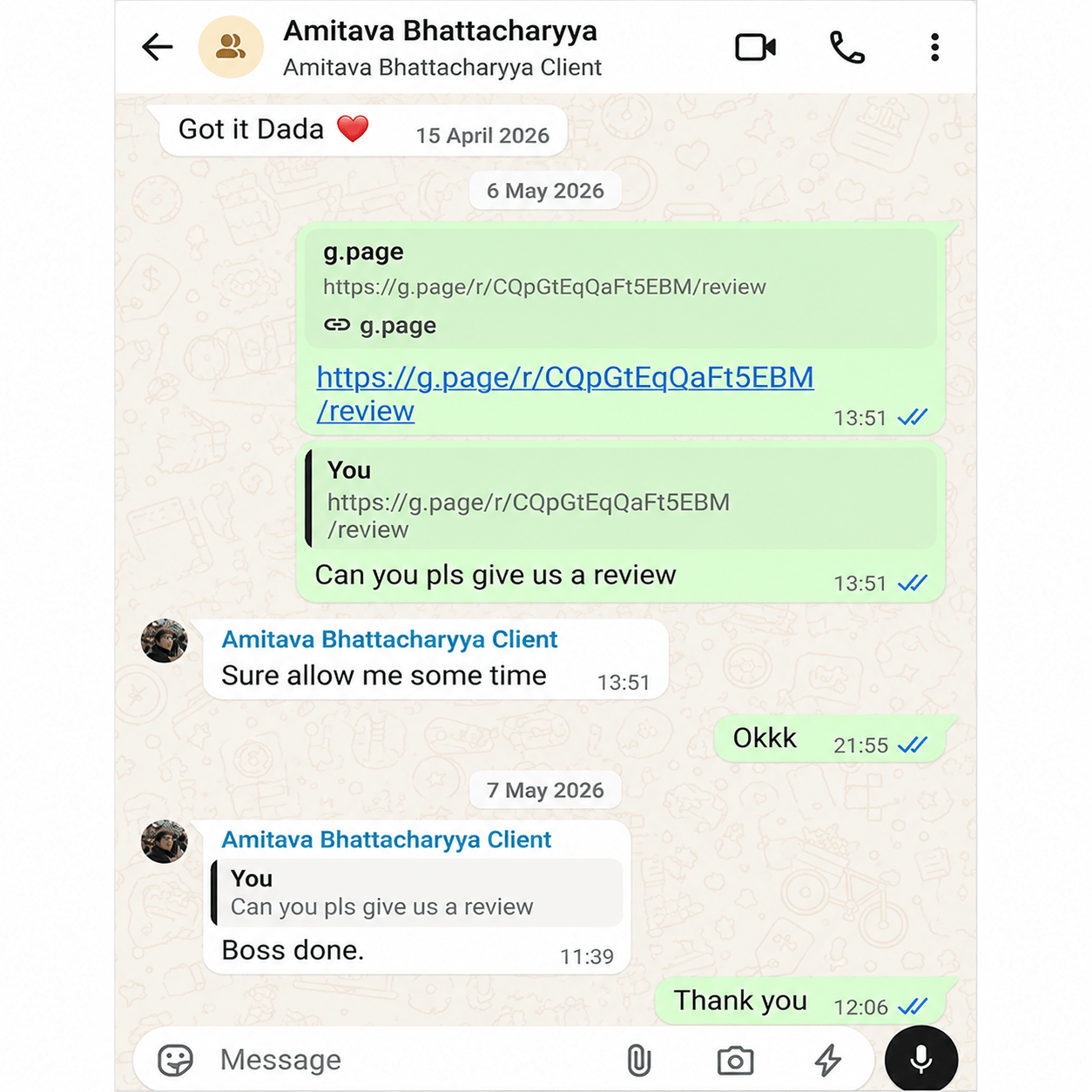
After the project support was completed, Amitava was invited to share feedback. He requested some time to review the work and returned the following day to confirm that his review had been completed, providing documented closure to the support process.
Client Review
Amitava Bhattacharyya
“Big shoutout to Biplab and Kusal for all the help. These guys are super knowledgeable and don’t just give you generic advice—they actually take the time to understand what you need and walk you through it. If you’re looking for someone who is easy to talk to and really knows their stuff, they are the best. Definitely worth reaching out to.”