A Beginner’s Guide to Reading SPSS Output Tables
Learn how to read the most common SPSS output tables without feeling overwhelmed. A beginner-friendly guide to what to look for and how to interpret
T-Test vs ANOVA: Which Statistical Test Should You Use?
Understand the key differences between t-tests and ANOVA, learn when each statistical test should be used, and avoid common mistakes when choosing a test.
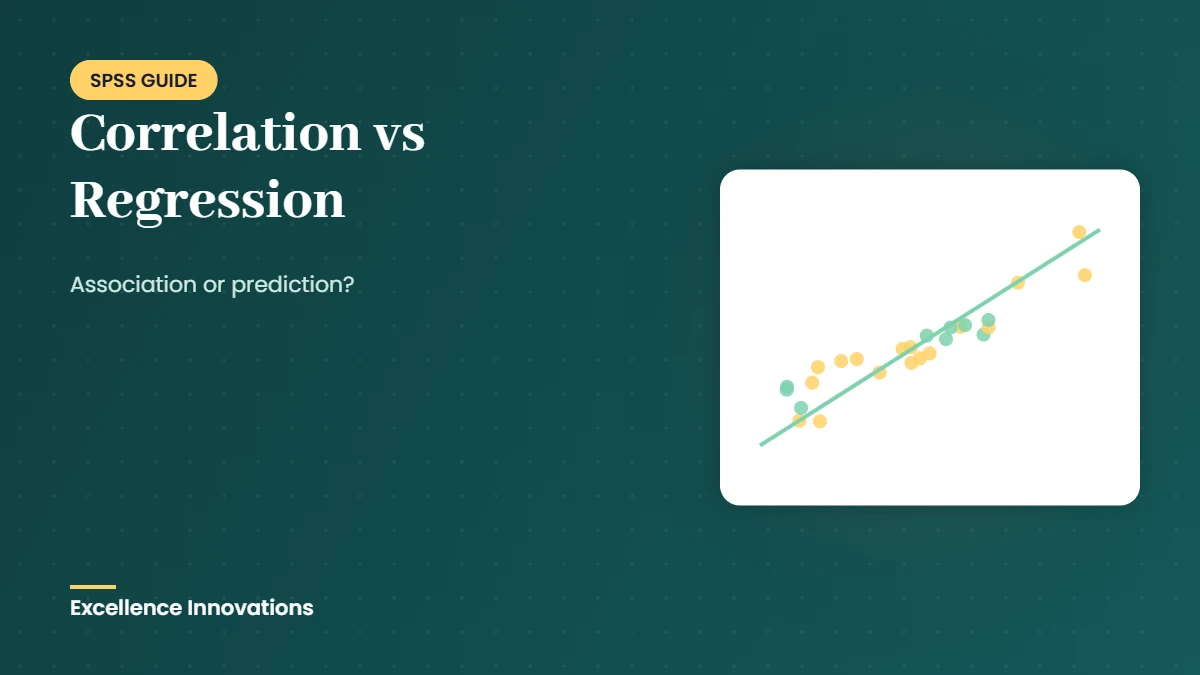
Correlation vs Regression: What’s the Difference and When to Use Each
Understand the difference between correlation and regression, when each technique should be used, and how to interpret your statistical results correctly.

How to Use AI Without Violating Academic Integrity in Your Literature Review
Use AI responsibly in your literature review: treat it as an assistant, verify every source, write in your own words and follow your university's AI
Best AI Tools for Literature Reviews in 2026
Compare the best AI tools for literature reviews in 2026: ChatGPT, Elicit, SciSpace, ResearchRabbit and Consensus. What each does best and how to use them
AI vs Human Literature Reviews: Which Produces Better Academic Research?
AI is fast at searching and summarising, but humans evaluate evidence and build arguments. Compare AI and human literature reviews and learn how to combine
How AI Tools Are Transforming Literature Review Writing
See how AI tools like ChatGPT, Elicit, Consensus, SciSpace and ResearchRabbit speed up literature search, summaries and writing, and how to use them responsibly.
How to Run and Interpret a Regression Analysis in SPSS (Step-by-Step)
Learn how to run a linear regression in SPSS step by step and interpret R, R², the ANOVA table, significance values and regression coefficients correctly.
How to Handle Missing Data in SPSS: Listwise Deletion vs Multiple Imputation
How to handle missing data in SPSS: when listwise deletion is acceptable, when multiple imputation is better, MCAR vs MAR vs MNAR, and how to[…]
How to Read a Marker’s Rubric for a Statistics Chapter: What Examiners Are Actually Scoring
Learn what examiners actually score in a dissertation statistics chapter: test justification, assumptions, interpretation, effect size and hypothesis alignment.
Common SPSS Output Misinterpretations: Why Correlation ≠ Causation Is Only Half the Story
Correlation ≠ causation is only half the story. Learn three SPSS output mistakes students make: p-values vs effect size, Levene’s test and causal claims.
SPSS Data Cleaning Before Analysis: The Step Most Students Ignore
Clean data before you run SPSS tests. Learn how to handle missing values, outliers, duplicates, reverse coding and normality checks for accurate dissertation results.
Payment Method







Google rating: 4.9/5 (26 reviews) │ Academic support based in Kolkata, India
© 2026 Excellence Innovations. Created for free using WordPress and Kubio
 Excellence Innovations
Empowering Your Academic Success
Excellence Innovations is a trusted academic writing & research partner.
Privacy Policy | Terms & Conditions | Disclaimer | Payment Details | Refund & Cancellation Policy | Money-Back Guarantee | Academic Integrity & Fair Use Policy
📄
Originality review
Similarity report available where agreed
⏰
On-Time Delivery
Deadlines
🎧
Direct Project Support
Response times vary by project
🏆
Serving students since 2019
Based in Kolkata, India
🔒
Confidential handling
See our Privacy Policy
📄
Turnitin similarity report
Availability confirmed per project
