
Last updated on August 25th, 2026 at 12:09 pm
Can ChatGPT Replace SPSS, AMOS, or SmartPLS?
Learn whether ChatGPT can replace SPSS, AMOS, or SmartPLS, where it helps most, where it falls short, and how researchers can use all four tools wisely.
ChatGPT is changing the way people handle data analysis, but it is not a full replacement for SPSS, AMOS, or SmartPLS. The practical answer is that ChatGPT works best as a support tool, while SPSS, AMOS, and SmartPLS remain the more reliable choices for final statistical execution and validation.
Introduction
Researchers, students, and business analysts now use AI tools for faster workflows, simpler explanations, and cleaner documentation. That has created a big question: can ChatGPT replace traditional statistical software? Based on recent comparisons, ChatGPT can handle some analysis tasks well, but the most dependable approach is to use it alongside specialized software.
What each tool is for
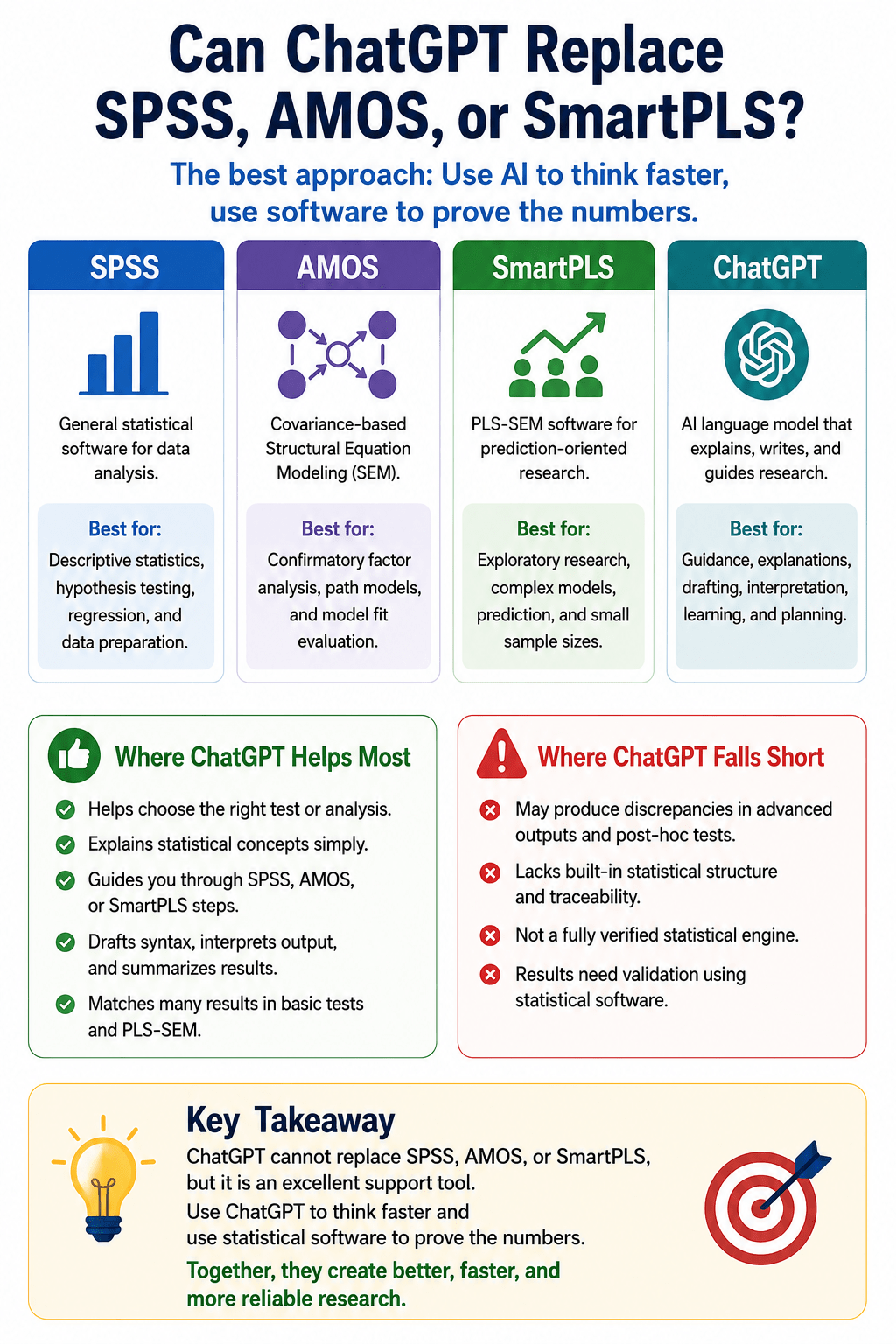
SPSS is a general-purpose statistical package used for descriptive statistics, hypothesis testing, regression, and data preparation. AMOS is designed for covariance-based structural equation modeling, while SmartPLS is built for partial least squares structural equation modeling and prediction-oriented research. By contrast, ChatGPT is a language model that can explain methods, write syntax, and sometimes reproduce interpretation of results, but it is not a dedicated statistical engine in the same sense. Therefore, it can be stated that ChatGPT can help throughout the statistical analysis, but it can not be replaced in overall statistical analysis.
Where ChatGPT performs well
ChatGPT is especially useful at the beginning and end of the research process. It can help you decide which test to use, explain output in plain language, draft interpretations, summarize findings, and even guide you through SPSS, AMOS, or SmartPLS steps. Studies comparing ChatGPT with SPSS and SmartPLS show that it can match many simpler results, especially for basic statistical tests and some PLS-SEM outputs.
For many users, this means ChatGPT saves time. Instead of searching through menus or dense statistical manuals, you can ask it to translate a research problem into a workable analysis plan. That is valuable for beginners, busy professionals, and researchers who want faster drafting and clearer communication.
Where ChatGPT falls short
The main limitation is reliability in complex or high-stakes analysis. Comparative studies report that ChatGPT can produce discrepancies in post-hoc tests, confidence intervals, and more advanced outputs, which means the numbers still need validation before publication or decision-making. In PLS-SEM comparisons, ChatGPT has shown strong agreement with SmartPLS in many cases, but researchers still note small methodological inconsistencies and an opaque computational process.
ChatGPT also lacks the built-in statistical structure and traceability of SPSS, AMOS, and SmartPLS. Those software tools are built to estimate models directly, display diagnostics clearly, and support reproducible workflows. ChatGPT can explain the analysis, but it does not replace the software environment that generates and verifies the results.
Practical comparison table
Tool | Best use | Strengths | Weaknesses |
SPSS | General statistics and data preparation | Reliable, structured, widely accepted | Less conversational, can feel slow for beginners |
AMOS | Covariance-based SEM | Strong for path models and fit indices | Requires methodological skill and licensing |
SmartPLS | PLS-SEM and prediction-focused modeling | Flexible, practical, good for exploratory work | Still needs statistical judgment |
ChatGPT | Guidance, explanations, drafting, interpretation | Fast, conversational, great for learning | Not a fully verified statistical engine PubMed. |
Best workflow for researchers
The most practical workflow is hybrid rather than either-or. Use ChatGPT to clarify your research question, suggest the right analysis path, draft syntax, and explain the output, then use SPSS, AMOS, or SmartPLS to compute and validate the final results. This approach gives you speed without sacrificing statistical confidence.
Example: if you are running a survey study, ChatGPT can help you decide whether regression, mediation, or SEM is appropriate, but SPSS, AMOS, or SmartPLS should still generate the actual coefficients, model fit, and significance values. That is the safest way to combine AI convenience with research rigor.
Real world application of combining statistical software with ChatGPT
Plenty of universities, research institutes, healthcare facilities, and companies are already using ChatGPT with statistical software. ChatGPT is not a replacement for statistical tools; instead, it is a complement to them to help streamline the overall research process by minimizing planning, documentation, and interpretation time. AI helps researchers concentrate on the quality of their research, making complex statistical concepts more accessible and streamlining their workflow.
In academic research, the selection of appropriate statistics to use for the research questions is often a problem with postgraduate students. ChatGPT can provide a simple explanation of the differences between t-tests, ANOVA, multiple regression, logistic regression, mediation analysis, moderation analysis, and structural equation modelling. Upon grasping the right technique, the researcher can use SPSS, AMOS, or SmartPLS to do the actual calculations statistically and obtain reliable results. This mix helps to break down barriers to learning and ensures methodological accuracy.
This mixed strategy is advantageous for business analysts as well. Businesses conduct customer satisfaction, employee engagement, marketing effectiveness, and financial analysis on a consistent basis. ChatGPT can help analysts create questionnaires, suggest appropriate analysis techniques, interpret statistical jargon for non-technical users, and compose executive summaries. But software like SPSS is still crucial for analyzing large amounts of data accurately, testing the assumptions and creating reliable statistical reports to help make strategic decisions.
Future of AI in Statistical Analysis
In the upcoming years, AI is likely to become even more crucial in statistical analysis. Enhanced data preparation, model selection, and result interpretation are just some of the features already being implemented in statistical software with the help of new AI technologies. AI is not intended to replace existing software such as SPSS, AMOS, or SmartPLS, but rather to enhance them by providing an intelligent assistant that automates repetitive tasks and minimizes human error. While statistical knowledge, assumptions, and critical analysis of results will still be critical, AI systems can enhance efficiency by providing real-time advice and streamlining complex analytical processes.
Conclusion
Can ChatGPT replace SPSS, AMOS, or SmartPLS?
The answer is no for full replacement, but yes for useful support in many research tasks. ChatGPT is excellent for explanation, planning, and drafting, while SPSS, AMOS, and SmartPLS remain the stronger tools for formal statistical analysis, reproducibility, and publication-ready output. For anyone working in research, analytics, or academic writing, the best mindset is simple: use ChatGPT to think faster, and use statistical software to prove the numbers. That combination is already changing how modern analysis gets done.









Comments are closed