
Writing a thesis is often presented as a simple equation: choose a topic, conduct research, write the chapters and submit. In reality, the process is rarely that predictable. A thesis involves research design, literature searching, ethics approval, data collection, analysis, writing, supervisor feedback and multiple rounds of revision. The actual time required can therefore be very different from the timeline students initially imagine.
So, how long does it really take to write a thesis?
The honest answer is that there is no single timeline that applies to every student. However, you can make a much more accurate estimate by understanding where your time is likely to go. For many students, the biggest mistake is treating the thesis as a writing project. It is better understood as a research project that eventually produces a written document.
A typical thesis may involve the following stages:
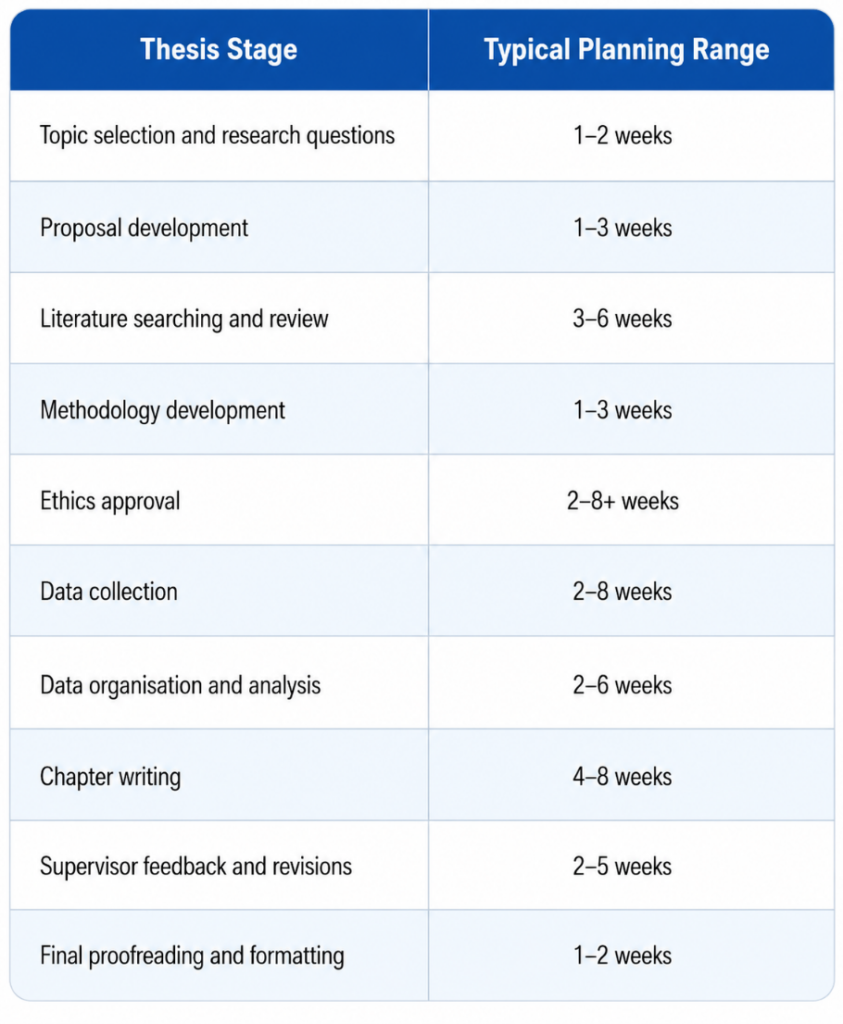
These figures are planning ranges rather than universal averages. A literature-based dissertation may move much faster because there is no participant recruitment. A qualitative study may take longer because interviews must be arranged, transcribed and analysed. A quantitative study may require additional time for data cleaning, statistical testing and interpretation. The important point is that the thesis timeline depends on the research design.
Why Word Count Can Be Misleading
Students often measure progress using word count.
For example, someone writing a 15,000-word dissertation might think that completing 7,500 words means they are halfway finished. That is not necessarily true. The introduction and literature review may be relatively straightforward compared with the findings and discussion chapters. Once data collection is complete, the student may still have to analyse the evidence, interpret the findings and connect them to previous research. A better measure of progress is completed research tasks, not simply the number of words written.
For example:
Research question finalised — complete
Literature search — complete
Ethics approval — complete
Data collection — 80% complete
Data analysis — not started
Findings — not started
Discussion — not started
Final revision — not started
This gives a much more realistic picture of how close you actually are to submission.
The Hidden Work Behind Primary Research
Primary research can make a thesis timeline considerably less predictable. Consider a qualitative dissertation based on interviews. A student might assume that ten interviews mean ten hours of work. In reality, each interview may involve participant recruitment, scheduling, consent, interviewing, transcription, transcript checking, anonymisation, coding and interpretation.
The same principle applies to quantitative research. Collecting a questionnaire dataset is only the beginning. The researcher may have to check missing values, identify incorrectly entered responses, code variables, test assumptions, conduct statistical analyses and interpret the results.
Therefore, when planning a thesis, don’t ask only:
“How long will data collection take?”
Ask:
“How long will everything associate with the data take?” That distinction can add weeks to a realistic project schedule.
The Supervisor Factor
Another commonly underestimated part of thesis planning is supervisor feedback. Students sometimes create a schedule in which they submit a chapter on Monday, receive comments by Friday and submit the revised version the following week. Academic supervision rarely works that neatly.
Supervisors may be managing multiple students, teaching, marking, conducting research and attending meetings. Feedback may therefore take longer than expected. Even when feedback arrives quickly, responding to it can require substantial work. A comment such as “strengthen the critical analysis” might require several additional academic sources, restructure paragraphs and rewriting an entire section. For this reason, your thesis schedule should include time for feedback and revision, rather than treating feedback as a final five-minute proofreading exercise.
The Thesis “Unexpected Problems” Factor
Almost every major research project encounter something unexpected. A participant may withdraw. Recruitment may be slower than anticipated. An ethics application may require amendments. A questionnaire may produce unusable responses. A statistical test may not be appropriate for the data. A key article may be difficult to access. Your supervisor may request substantial changes.
These situations do not necessarily mean that the research has failed. They simply demonstrate why a thesis timeline should contain contingency time. If you have twelve weeks remaining, do not create a plan that requires twelve weeks of perfect productivity.
A contingency period is not wasted time. It is protection against the uncertainty that naturally exists in research. Calculate your thesis time in hours One of the most useful ways to create a realistic deadline is to stop thinking only in months and start thinking in available working hours.
For example, suppose you have 12 weeks remaining and can realistically dedicate 15 hours each week to your thesis.
That gives you:
12 × 15 = 180 available hours
Now estimate your remaining workload. If you believe your outstanding tasks will require approximately 220 hours, you have identified a problem before it becomes a crisis.
You could then:
- reduce the scope of unnecessary work;
- reorganise your priorities;
- increase available study hours where possible;
- discuss the situation with your supervisor;
- or revise your project plan.
This is considerably more useful than simply telling yourself to “work faster”. Different Research Designs Need Different Timelines. A literature-based dissertation can sometimes be completed within a shorter period because there is no primary data collection. However, literature reviews have their own danger, which is endless searching.
There is always another article to read. The solution is to establish clear search terms, databases, inclusion and exclusion criteria and a defined screening process. Quantitative dissertations may require more time for dataset preparation and statistical analysis. Researchers should also allow time to investigate unexpected results rather than assuming that the planned analysis will always work perfectly. Qualitative dissertations can involve significant hidden work through recruitment, interviewing, transcription, coding and thematic analysis.
Therefore, two students writing dissertations of the same word count may require completely different amounts of time.
How Much Does Thesis Editing and Proofreading Actually Cost? (2026 Pricing Breakdown)
Submitting a thesis is one of the most important milestones in a student’s academic journey. However, even a well-researched thesis can lose marks because of grammatical errors, inconsistent formatting, unclear arguments, or referencing mistakes. This is why many students invest in professional thesis editing or proofreading before submission. The question is “how much should you expect to pay in 2026?”
The cost of thesis editing depends on the type of service you need, the total word count, the subject area, and the turnaround time. Understanding these differences can help you choose the right service without overspending.
2026 Thesis Editing and Proofreading Pricing
| Service Type | Typical Price (USD) |
| Proofreading | $15–25 per 1,000 words |
| Copy Editing | $25–45 per 1,000 words |
| Academic Thesis Editing | $45–80 per 1,000 words |
| Structural or Substantive Editing | $60–100+ per 1,000 words |
For a 20,000-word Master’s thesis, proofreading typically costs $300–500, while comprehensive academic editing usually ranges from $900–1,600. Larger PhD theses of 60,000–80,000 words may cost anywhere between $900 and $4,000+, depending on the level of editing and delivery speed.
What’s the Difference Between Editing and Proofreading?
Many students confuse these services, but they serve different purposes.
- Proofreading focuses on correcting spelling, grammar, punctuation, typos, and minor formatting inconsistencies.
- Copy editing improves sentence structure, academic language, readability, and consistency without changing your ideas.
- Academic thesis editing enhances clarity, logical flow, transitions, and overall presentation while preserving your research.
- Structural editing provides detailed feedback on chapter organisation, argument development, and coherence across the thesis.
Choosing the appropriate service depends on whether your content is already complete or still needs refinement.
What Affects the Cost?
Several factors influence the final price:
- Word count: Longer theses require more editing time.
- Deadline: Urgent 24–48 hour services usually cost significantly more.
- Subject complexity: Technical, medical, engineering, or legal theses often attract higher rates because they require specialist editors.
- Formatting requirements: APA, Harvard, MLA, Chicago, or university-specific formatting checks may be offered as additional services.
How to Get Better Value for Your Money
Before paying for editing, revise your thesis carefully to remove obvious mistakes. Booking several days before your submission deadline can also help avoid expensive rush fees. Requesting a sample edit is another good way to evaluate an editor’s quality before committing to a full thesis.
Is Professional Thesis Editing Worth It?
Professional thesis editing is particularly valuable for postgraduate students, international students writing in English, and researchers submitting dissertations for final assessment. Ethical editing improves language, clarity, formatting, and consistency without altering your original research or findings.
Final Thoughts
In 2026, students should budget approximately $300–900 for a typical Master’s thesis and $900 or more for a PhD thesis, depending on the level of editing required. Rather than choosing the cheapest option, compare services based on editor expertise, confidentiality, revision policy, and turnaround time to ensure your thesis is submission-ready and meets academic standards.
Thesis Defense Questions You Won’t Find in Any Guide (Real Questions Students Were Actually Asked in Their Viva)
Most blogs about thesis defenses list the same predictable questions: “What is your research objective?” or “Why did you choose this topic?” While those questions do appear, many students are surprised by the follow-up questions examiners ask during real Master’s and PhD defenses. These questions test critical thinking, research ownership, and the ability to defend decisions under pressure—not just memorised answers.
Below are examples of challenging thesis defense questions that students across business, social sciences, engineering, healthcare, and humanities have commonly reported being asked during real viva examinations.
The Questions That Catch Students Off Guard
1. “If you had six more months, what would you change in this research?”
This question tests whether you recognise the limitations of your own study and can identify realistic improvements.
2. “Which finding surprised you the most, and why?”
Examiners want to know whether you genuinely analysed your results instead of simply reporting them.
3. “What evidence would convince you that your conclusion is wrong?”
This measures your academic objectivity and willingness to consider alternative interpretations.
4. “Why should anyone care about this research five years from now?”
A strong answer connects the study to long-term academic, industry, or policy relevance.
Questions About Your Methodology
These often become the longest part of a defense.
| Question | What the examiner is testing |
| Why did you reject other research methods? | Justification of methodological choices. |
| What assumptions did your methodology make? | Understanding of research design. |
| How did you reduce bias during data collection? | Research credibility and ethics. |
| If your sample doubled, would your conclusions change? | Reliability and generalisability. |
| What is the biggest weakness in your methodology? | Critical self-evaluation. |
The best responses acknowledge limitations while explaining why the chosen method was still appropriate for the research objectives.
Questions Based on Your Results
Examiners often focus on interpretation rather than statistics or data.
- Which result is the strongest evidence supporting your argument?
- Which finding contradicts previous literature?
- Why do two of your findings appear inconsistent?
- Could these results be explained differently?
- What result did you expect but never found?
These questions assess whether you understand the story behind the data rather than simply presenting tables or themes.
The “Stress Test” Questions
These questions deliberately challenge your confidence.
“Convince me your research is original in two minutes.”
A concise explanation of the research gap is more effective than summarising the entire thesis.
“What is the hardest criticism someone could make of your thesis?”
Examiners want to see intellectual maturity, not perfection.
“What would happen if your main hypothesis or argument did not hold?”
This checks whether your conclusions depend entirely on one assumption.
Field-Specific Viva Questions Students Report
Business and Management
- Why did you choose this theoretical framework instead of another competing theory?
- How can organisations apply your recommendations in practice?
- Are your findings relevant outside your chosen country or industry?
Social Sciences
- How did your own perspective influence data interpretation?
- Why did participants trust you with sensitive information?
- Would another researcher identify the same themes?
Engineering and Technology
- Why is your proposed model better than existing alternatives?
- What are the implementation challenges in real-world settings?
- How would your system perform under different conditions?
Health and Medical Research
- How do ethical considerations affect the validity of your findings?
- Would your recommendations change for another patient population?
- Which variable had the greatest influence on your results?
How to Prepare for Unexpected Defense Questions
Instead of memorising answers, prepare by reviewing the decisions you made throughout your thesis. Be ready to explain why you selected a research design, how you interpreted findings, what limitations remain, and where future research should go. Practising short, evidence-based responses is often more effective than rehearsing long speeches.
Final Thoughts
A successful thesis defense is rarely about answering every question perfectly. It is about demonstrating ownership of your research and responding thoughtfully when challenged. The most difficult viva questions are usually follow-up questions that explore your reasoning, not your memory. Preparing for these real-world questions will leave you far better equipped than relying on generic thesis defense guides alone.
How AI Detection Tools Are Actually Flagging Thesis Chapters (2026 Reality Check)
AI detection has become one of the biggest concerns for postgraduate students in 2026. With universities increasingly using tools such as Turnitin AI Writing Detection, GPTZero, Copyleaks, and Winston AI, many students worry that genuine thesis chapters could be incorrectly identified as AI-generated. The reality is more complex than most websites suggest.
Important note: There is no universal AI detector that can accurately determine whether a thesis was written by AI. Different tools often produce different results on the same document.
Why the Same Thesis Gets Different AI Scores
AI detectors do not identify ChatGPT or any other writing tool directly. Instead, they analyse patterns such as sentence predictability, vocabulary distribution, repetition, and writing consistency. Because each company uses a different detection model, the same chapter may receive very different scores across platforms.
For example, a literature review written in formal academic language is often considered “more predictable” than reflective or qualitative writing. As a result, some detectors assign a higher AI probability even when the text is entirely human-written.
What Independent Evaluations Show
Recent independent evaluations of popular AI detectors have found significant variation in accuracy.
| AI Detection Tool | What Independent Testing Found |
| Turnitin AI Detection | Best used as an indicator for institutions, not proof of misconduct. Universities are advised to review the report alongside human judgement. |
| GPTZero | Can identify some AI-generated text, but also produces false positives on academic writing. |
| Copyleaks AI Detector | Performs well on mixed AI-human content, but accuracy varies across disciplines and writing styles. |
| Winston AI | Provides probability scores rather than certainty and recommends manual verification. |
The key takeaway is that AI detection reports are risk indicators, not evidence that a thesis was generated by AI.
Which Thesis Chapters Are Most Likely to Be Flagged?
Some sections naturally have a higher chance of receiving elevated AI scores:
- Literature reviews with highly formal, repetitive academic language.
- Methodology chapters using standard research terminology.
- Long definitions or theoretical explanations written in a consistent style.
Chapters containing original analysis, interview findings, statistical interpretation, or critical discussion generally receive lower AI probabilities because they contain more unique language patterns.
How Students Can Reduce False Positives
- Write from an outline instead of generating complete paragraphs with AI.
- Include critical analysis, interpretation, and discipline-specific examples.
- Revise repetitive sentence structures and vary paragraph openings.
- Keep research notes and draft versions to demonstrate authorship if requested by a university.
The Bottom Line
AI detection tools are useful screening technologies, but they are not definitive proof of AI authorship. Universities increasingly combine AI detection reports with academic judgement, writing history, references, and supporting drafts before investigating potential misconduct. The safest approach is to use AI only for brainstorming or language support while ensuring that the thesis reflects original research, analysis, and academic reasoning.








Comments are closed