

Last updated on September 30th, 2026 at 01:16 pm
Starting university can be exciting, exhausting, and occasionally terrifying—sometimes all within the same week.
For students beginning their first trimester at Deakin University, one of the biggest adjustments can be getting used to an assessment-heavy learning environment. This can be particularly challenging for international students who come from education systems where final examinations carry most of the weight.
Instead of preparing for one major exam, you may suddenly find yourself juggling reports, presentations, case studies, reflective assignments, group projects and 1,500–2,000-word assessments with overlapping deadlines.
Then comes another challenge: getting an assignment mark that is lower than you expected.
You may spend days working on a report, believe you have followed the instructions carefully, submit it confidently—and receive a Credit instead of a Distinction, or even fail the assignment altogether.
It can hurt.
But one disappointing assessment result does not define your university performance. More importantly, learning how Deakin assignments are assessed can make a significant difference to your future results.

First: Is It Normal Not to Get HDs in Every Assignment?
Absolutely.
Students who were academically strong before university sometimes arrive expecting themselves to maintain the same pattern of top grades. However, university marking can be considerably different.
At Deakin, achieving an HD generally requires more than simply answering the question correctly. Strong assignments usually need to demonstrate critical analysis, appropriate evidence, excellent organisation, accurate referencing and very close alignment with the assessment rubric.
That means there can be a surprisingly large difference between a good assignment and an HD-level assignment.
Imagine a student receiving several HDs alongside Distinctions and a Credit while maintaining a WAM around 84. It may still feel disappointing when a particular assignment receives a lower grade than expected, but objectively, that student is performing extremely well.
If your scholarship requires you to maintain a WAM of 65 and your current WAM is substantially higher, one Credit or disappointing assignment is unlikely to suddenly destroy your academic standing.
Rather than thinking:
“Why didn’t I get an HD?”
a more useful question is:
“What prevented this assignment from reaching the next rubric band?”
That small change in thinking turns a disappointing grade into information you can actually use.
The Rubric Should Become Your Assignment Roadmap
Perhaps the most common advice shared by experienced Deakin students is deceptively simple:
Read the rubric.
Then read it again.
Many students look at the rubric just before submitting. A much better strategy is to use it while planning and writing the assignment.
Suppose one section of a rubric awards higher marks for “critical evaluation of relevant literature.”
Simply describing several academic articles probably will not satisfy that criterion at an HD level.
You may need to compare studies, identify contradictions, discuss limitations and explain why the evidence matters to your argument.
Likewise, if the rubric awards marks for professional presentation, referencing or logical organisation, those elements should not be treated as last-minute formatting tasks. They are part of the grade.
One student described believing they had completed an assignment extremely well after checking the rubric—only to discover that they had misunderstood a central part of the task. They had selected an employer when the assignment actually required an employer association.
Their writing itself was not necessarily the main problem.
They answered the wrong version of the question.
That is an important lesson: before trying to write brilliantly, make sure you are solving the correct problem.
Clarify the Assignment Before You Become Deeply Invested in It
A surprisingly effective way to improve assignments is asking questions early.
Students sometimes avoid contacting lecturers or tutors because they worry that their question will sound obvious. But discovering that you have misunderstood the assignment after receiving your grade is considerably worse.
If there is uncertainty about terminology, case selection, required structure or interpretation of the question, use the unit discussion board or ask your tutor.
You do not need to ask them to approve your entire assignment.
A simple clarification such as:
“Am I correct that this section requires evaluation of X rather than description of Y?”
can prevent hours of unnecessary work.
Tutors also know what students commonly misunderstand. Their explanation may reveal expectations that were not obvious when you initially read the task.
Proofreading Can Be the Difference Between Grade Bands
Consider another common situation.
A mature-age university student works extremely hard on their first assignment and receives a mark only 0.8% below a Distinction.
Later, they reread the submission and discover spelling mistakes, awkward sentences and small presentation problems they simply did not notice while writing.
That experience is frustrating because the lost marks can feel avoidable.
When you have been staring at the same document for hours, your brain begins reading what you intended to write rather than what is actually on the page.
That is why proofreading immediately after finishing an assignment is often ineffective.
Whenever possible, finish the substantive writing first and return to the document later with fresh eyes.
During the final review, examine four things separately: whether you actually answered the question, whether each section satisfies the rubric, whether your evidence and references support your claims, and whether the writing is clear and professionally presented.
Reading the assignment aloud can also reveal awkward sentences that look perfectly acceptable on screen.
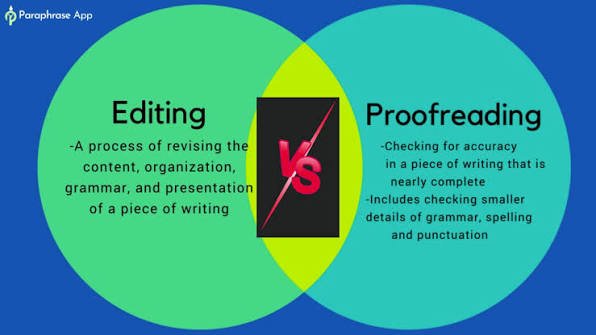
Can Someone Else Proofread Your University Assignment?
Many students understandably want another human to review their assignment before submission.
This can be especially valuable for first-time university students, students with ADHD, international students or anyone who struggles to identify errors in their own writing.
However, there is an important distinction between proofreading and feedback and having somebody substantially produce the assignment for you.
Appropriate support might identify unclear wording, grammar problems, inconsistent referencing, confusing paragraph structure or areas where your argument does not appear to satisfy the rubric.
The ideas, analysis and final academic work should remain yours.
University study-support services, tutors and academic-skills advisers can therefore be valuable resources. Rather than waiting until you receive a poor grade, use academic support while developing your assessment.
Even asking someone to read a paragraph and tell you what they think your main argument is can be revealing.
If they cannot identify it, your marker may struggle as well.

ADHD, Mental Health and Assignment Overload
Assignment optimisation is not always about learning another productivity technique.
Sometimes the real problem is simply capacity.
A student managing ADHD, serious mental-health difficulties, full-time placement or other responsibilities may genuinely be working close to their limit.
In those circumstances, comparing yourself with someone who can comfortably spend another five hours polishing an assignment is not particularly useful.
Access Plans and extensions exist for a reason.
Using them is not the same as lowering academic standards. They are mechanisms designed to give students a more equitable opportunity to demonstrate what they know.
For students with ADHD in particular, large assignments can become overwhelming because “write the report” feels like one enormous task.
Breaking the assessment into smaller actions can make starting easier:
Understand question → analyse rubric → collect sources → create headings → draft sections → edit argument → check references → proofread → submit.
You are still completing the same assignment, but mentally it becomes eight manageable tasks instead of one intimidating project.
What If You Actually Fail an Assignment?
This is where university anxiety can escalate very quickly.
Imagine receiving 16.6 out of 40 on an assessment worth 40% of the unit.
It is understandable to immediately think:
“I’ve failed the unit.”
But mathematically, that is not necessarily true.
You have earned 16.6 percentage points toward the final unit result.
If there are another two assignments worth 20% and 40%, then 60% of the unit is still available.
Assuming the unit simply requires an overall mark of 50 and has no separate hurdle requirement, you would need another:
50 − 16.6 = 33.4 marks
from the remaining 60 marks available.
That means averaging approximately:
33.4 ÷ 60 × 100 = 55.7%
across the remaining assessments.
Suddenly, the situation looks very different.
You do not necessarily need two HDs to recover.
You need to understand what went wrong and perform reasonably well on the remaining work.
Of course, always check the official unit requirements because some assessments may have hurdle conditions.
A Bad Assignment Can Become a Very Useful Wake-Up Call
Several students describe receiving unexpectedly poor marks after previously performing well.
One student received around 43% on an assignment after expecting something closer to 65%. Another had performed strongly on an earlier assessment and found the lower result particularly difficult to process.
Experiences like these can feel brutal.
Yet sometimes the disappointing assignment becomes the one that teaches the most.
It forces you to examine how markers actually interpret the rubric, where your argument became descriptive, how structure affected readability or whether you misunderstood the task.
Another student who initially struggled eventually passed the unit and described focusing heavily on the final assessment.
The lesson is not that marks do not matter.
It is that one mark does not tell you how the rest of the trimester must end.
Analyse Marker Feedback Instead of Simply Reading It
When feedback arrives, students often read it emotionally.
They see:
“Insufficient critical analysis.”
Their brain translates it into:
“You are bad at academic writing.”
That interpretation is useless.
Instead, convert feedback into an action.
0258
“Insufficient critical analysis” might mean:
Next assignment: after presenting evidence, compare perspectives and explain their implications rather than simply summarising them.
“Poor structure” becomes:
Next assignment: create headings and paragraph-level arguments before drafting.
“Limited evidence” becomes:
Next assignment: support major claims with stronger academic sources.
“Does not fully address the question” becomes:
Next assignment: highlight every instruction word and map it to a section before writing.
Keep these lessons somewhere accessible.
Eventually you build your own personal assignment checklist based on mistakes you have actually made.
That checklist can become considerably more valuable than generic study advice.
Stop Chasing the Extra 5% Everywhere
Students aiming for HDs sometimes spend enormous amounts of energy polishing sections that already satisfy the rubric.
The better strategy is to identify where the marks actually are.
If your introduction is already clear, spending another two hours rewriting it may accomplish very little.
If your analysis is weak and analysis represents 30% of the rubric, that is where those two hours should go.
Think of assignment preparation as resource allocation.
You have limited time and energy.
Use them where they have the highest potential impact on your grade.
This becomes particularly important during trimester crunch time, when students may simultaneously face several 1,500–2,000-word assessments, placement responsibilities and overdue tasks.
Sometimes the goal is not perfection.
Sometimes the goal is simply to keep the train moving.

The Most Important Lesson: A Grade Is Feedback, Not a Verdict
Getting a Credit after expecting a Distinction hurts.
Missing a Distinction by 0.8% hurts.
Failing an assignment worth 40% hurts even more.
But none of those results automatically determines what happens next.
University assessment is partly about learning the subject and partly about learning how academic work is evaluated.
That second skill develops through experience.
Your first trimester may therefore involve mistakes: misunderstanding a task, overlooking spelling errors, discovering that your writing is too descriptive, misreading a rubric or underestimating how long a report will take.
Those mistakes are frustrating, but they also give you information.
Use the rubric before writing.
Clarify uncertainty with your tutor.
Leave time for proofreading.
Use university study support.
Analyse feedback carefully.
Calculate your actual grade position instead of assuming the worst.
And when one assessment goes badly, focus on what is still mathematically and academically achievable.
Most importantly, remember that university is not a competition to produce an uninterrupted sequence of HDs.
An HD is excellent.
A Distinction is a strong result.
A Credit is still a successful result.
And sometimes simply getting through an exceptionally difficult trimester while continuing to learn is an achievement in itself.
The goal is not to submit a perfect assignment every time.
The goal is to become noticeably better at the next one.









Comments are closed